
The Self-Report Gap: I Audited 4,785 Agent Claims Against What Actually Ran


Codex told me it had verified something. It hadn’t. Not “it ran the wrong command” — it had run no commands at all, in the entire session, before writing "verification": ["Compared both chapter-1 sandbox outputs"] into its structured memory block.
Then I checked the other 4,784 blocks. What I found made me rewrite the conclusion twice — the second time because I’d blamed the wrong thing.
Why there’s a memory at all
Every coding session produces knowledge that dies with it — what broke, what I’d already tried, which file was the one that mattered. So I built ContextNest: a local Rust service that stores what past sessions learned and hands it back to the next one.
Storage was never the hard part. What to store was. A raw transcript is 50,000 lines of tool spam; what the next agent needs is small — what did you decide, what broke, what did you verify, what did you ship.
The idea that looked clever
Have the agent tell me. At the end of every turn, each agent emits a structured block that types the turn into fields:
{
  "goal": "wire the retry loop into the dispatcher",
  "decisions": ["exponential backoff over fixed — the API rate-limits in bursts"],
  "failures": ["first attempt deadlocked; the lock was held across the await"],
  "verification": ["cargo test --lib dispatcher → 14 passed"],
  "delivered_features": [{"feature": "retry loop", "files": ["src/dispatch.rs"]}]
}
A hook types each field into a memory kind and ingests it. Zero human labeling. The agent knows what it just did better than any parser could — it has the intent, the reasoning, the discarded options.
That last sentence is the mistake. It took two months to see it, and I only saw it by going back and grading every block against what actually ran.
The audit
I wrote a script the agent can’t talk its way past: walk the transcript, record every Edit, Write, and shell call, then check each block’s claims against them.
96 sessions. 4,785 blocks. 46 Claude, 50 Codex. Same criteria for both.
| Defect | Claude | Codex |
|---|---|---|
| Claimed shipping a feature, no edit anywhere in the session | 0.2% | 24.4% |
| Edited files, then didn’t record which files | 26.3% | 13.6% |
| Claimed a verification, no command ever ran | 0.0% | 90.2% |
Read files, left read_context empty | 10.4% | 0.0% |
They fail in opposite directions. Claude under-records what it did. Codex over-claims what it didn’t.
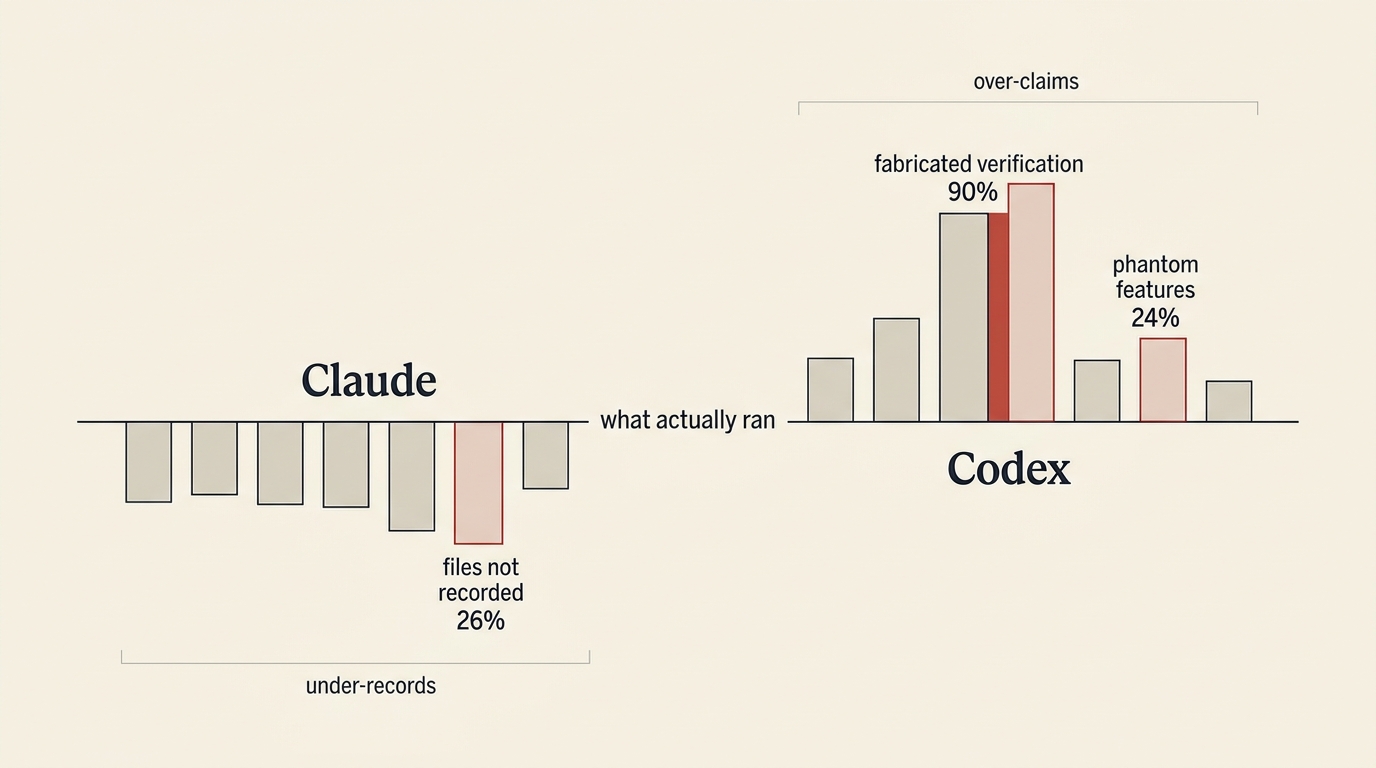
The per-session distribution is the part that stops you: 26 of 50 Codex sessions are 100% defective on verification claims. Only 2 are clean. On the Claude side, 44 of 44 sessions are clean on that same axis — not one fabricated verification.
I got this wrong three times first
The 90% looked so implausible I assumed it was my bug. It took three failed attempts to convince me otherwise, and every one of them was my script:
| Hypothesis | Test | Result |
|---|---|---|
| My parser missed Codex’s commands | Codex wraps shell as {"cmd":"..."}, not cmd: "..." — fixed the regex | Number didn’t move |
| One turn streamed as many blocks | Counted real turn boundaries | 0.8 blocks per turn — one per turn, by design |
| My “user prompt” detector was wrong | Counted them | I was treating 4,028 tool-return envelopes as user prompts |
Two of my defect rates came back as exactly 0% and exactly 100%. That is not a finding. A defect rate that lands on a round number across every bucket is a tell for a broken measurement, and both times it was. Hold onto that — it turns out to be the whole story.
Then I stopped scripting and read one transcript
Four minutes of reading beat three script iterations, and it produced a different diagnosis.
Here is the actual session timeline. Read it from left to right; each character is one transcript event:
z: a structured<z-insight>report with no verification claim.V: the same report format, but with a claim insideverification[].E: an executed shell command. This is where a real verification receipt can come from.D: a non-shell coordination call. It can move the work along, but it does not prove that a check ran.
Repeated letters mean repeated events in chronological order.
zVVVVVVVVVVVzVVVVVzEEDEEEEEDEDEEEDEEDEDDEDEEDEDEDEDEDDEEEDDV
└──── 17 verification claims ────┘└──── all 24 shell commands ────┘
Every claim comes before every command. Sixteen of the seventeen had zero commands before them.
The work does happen — 24 shell calls in that session. But the agent writes the report before doing the work. The verification field describes what it is about to do. It isn’t inventing tools it never had; it’s reporting in the future tense, and my extractor stores it as past tense.
No script found that. It took reading the timeline in order.
It wasn’t dishonesty — it was the trigger
My first draft said the divergence was in the models: Codex the fabricator, Claude the amnesiac. Then I tested a duller hypothesis — that I’d configured the trigger wrong — and it held. Across 20 recent Codex sessions:
- 93% of its insight-turns did no verifying work at all.
- 83% of those no-work turns still emitted a verification claim.
- Every turn that did real work claimed verification correctly — 21 of 21.
The bug is the trigger. I built a form that demands a verification report on turns where the honest answer is “nothing to report,” and then I was surprised the form got filled in. Read those numbers together and the mechanism is right there: when Codex actually runs a command, it reports honestly (21 of 21); the fabrication is concentrated entirely on the turns where it did nothing, because the instruction I gave both agents says emit this block every turn, including short ones. A generative model handed a mandatory verification field on an empty turn will fill it. That is a model doing exactly what it was told, not a model lying.
I’m not the first to hit this
Once I had the name for the shape, the literature had it too — and at a scale my 96 sessions can’t touch.
The failure mode has a term now: false success. Characterizing False Success in LLM Agents measures it across 9,876 + 1,879 trajectories with text-independent ground truth — agents “asserting task completion when the environment state shows otherwise” — and finds it accounts for 45–48% of failures in some settings. My 90% is one corner of a documented, corpus-scale problem.
The mechanism I read off that one timeline has a name too. When Agents Commit Too Soon calls it premature commitment: “they settle on one reading of the evidence early, then spend the rest of the run defending it… final-answer scoring misses the failure mode.” Writing the report before the work is the same collapse, one turn wide.
Underneath all of it sits the reason a sterner prompt can’t fix this: models don’t have privileged access to their own execution. Can LLMs Introspect? A Reality Check argues apparent introspection isn’t distinguishable from surface pattern-matching; Song et al. found 21 models fail to introspect even about their own knowledge; and last month, Can LLMs Reliably Self-Report Adversarial Prefills? found no model reliably recognizes when its own prior response was manipulated. When an agent tells you what it did, it is not reading a log — it is generating text that sounds like what it probably did. I wasn’t collecting a report. I was collecting a second inference pass, from the same distribution as the first, with worse information.
The post-hoc rationalisation framing (2508.19827, 2503.08679) wasn’t wrong; it explains why a self-report is unreliable. It just doesn’t tell you to stop asking for one.
The fix isn’t a better narrator — it’s a receipt
The obvious next move — the one I nearly built — is a worker that reads the turns and produces the insights instead of the agent. That’s the same mistake wearing a hat: a summarizer is still an LLM writing a self-report, one with less context than the agent had.
The transcript already holds the truth, free and impossible to hallucinate. From Agent Traces to Trust puts the principle plainly: “final-answer accuracy alone cannot explain how an output was produced, which evidence supported each claim.” So the extractor stops asking and starts deriving:
- Which files were edited? Every
Edit/Writecall, with its path — not the agent’s memory of them. - Did it ship anything? Whether an edit happened at all.
- Did it verify? Whether a command ran — and when, relative to the claim.
A verification whose command runs after the block is tagged claimed, not observed, and ranks below things that actually happened. A feature claiming files that were never touched grades absent. None of it needs the model’s cooperation.
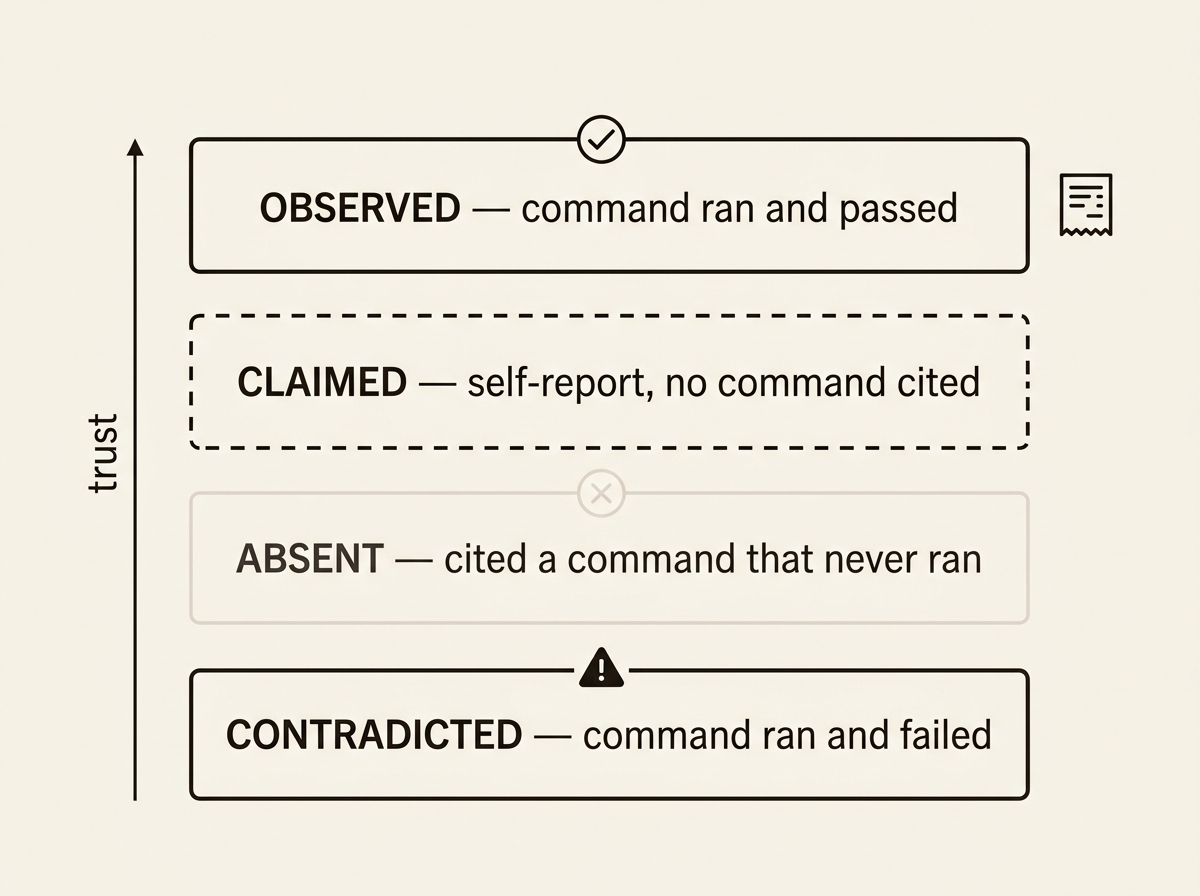
One caveat the newest work insists on, and I’ll pass it along: a receipt is stronger evidence than a self-report, not incorruptible. Trust No Tool shows tool feedback itself can be adversarial. The tool-call record is the best ground truth in the transcript — it is not an oracle. So this is a trust ladder, not a lie detector.
What shipping it actually taught me
Two things I didn’t expect.
First, when I went to enforce provenance in my own store, I found the grader had been blind the whole time. Claude nests tool calls inside a message; Codex emits each as its own top-level event. My index only understood the Claude shape — so for every Codex session, the edit set came back empty and every claim entered ungraded. The grader wasn’t scoring Codex badly. It couldn’t see Codex at all. A grading system that silently can’t see its evidence looks exactly like one that finds nothing wrong.
Second, I wanted to know whether “it’s the trigger, not the model” survives a model swap. So I ran the same fix task through four models under one harness — Opus, Kimi K2.7, MiniMax-M3, GLM-5.1 — with a contract that doesn’t demand a verification field every turn. Then the sandbox denied their verify command: the exact condition that used to manufacture a fabricated claim.
Not one fabricated. GLM wrote “verification command denied twice by permission layer — user must run the confirm command manually.” MiniMax filed a structured request telling me which command to run. Three vendors, the same temptation, and every model declined to claim what it hadn’t done. It’s one task each — a portability check, not a statistic. But the receipt-gating carried, and the fabrication didn’t return once the trigger stopped forcing it.
The line worth keeping
Split what you ask an agent to report by whether a receipt exists.
Objective — which files, did it ship, did it verify. A receipt is in the transcript. Derive it. Never ask.
Subjective — what was I trying to do, what did I decide, what am I assuming. No receipt exists; the agent is the only witness.
And here is the part that surprised me: on the subjective fields, both agents are flawless. goal and progress were correct in all 4,785 blocks, both models, zero misses. They are excellent at telling you what they were trying to do, and unreliable about what they mechanically did — which is precisely the part you never needed them for.
The detection fingerprint is the same one that caught my own scripts landing on 0% and 100%: a blind instrument’s silence is indistinguishable from a verdict. An agent asked to verify on an empty turn, a grader that can’t parse a whole class of session, a review gate with no diff to read — each returns something confident and wrong, and none of them raises an error. Before you trust any reading, prove the instrument could have seen the thing it’s reporting on. If a field in your schema could have been proven from the transcript and you’re still asking the model for it, that field is fiction waiting to happen.
Comments
Sign in with GitHub to leave a comment. Threads live on SourceShift/blog-comments — moderated.